Uber eats:
Design challenge
UBER EATS:
DESIGN CHALLENGE
DURATION:
9 Hours
Feb. 2026
CONTEXT:
Design Challenge
UX/UI
ROLE:
Product Design
Interaction Design
TOOLS:
Figma
Uber Eats
Uber Driver
DURATION:
9 Hours
Feb. 2026
CONTEXT:
Design Challenge
UX/UI
ROLE:
Product Design
Interaction Design
TOOLS:
Figma
Uber Eats
Uber Driver
Pick a widely used digital ecosystem and design a climate-positive upgrade that fits inside it. Don't reinvent the product — design a layer, rule, or system tweak that nudges behavior at scale.
Pick a widely used digital ecosystem and design a climate-positive upgrade that fits inside it. Don't reinvent the product — design a layer, rule, or system tweak that nudges behavior at scale.
PROBLEM STATEMENT
PROBLEM STATEMENT
Why?
Why?
In Uber Eats, deliveries are routed on an on-demand, immediate basis, often resulting in fragmented routes and unnecessary back-and-forth driving. While drivers may receive stacked orders, these additions are unpredictable and occur after a delivery is underway. By prioritizing speed over coordination, the system encourages single or inefficient routes, increasing mileage and fuel consumption.
In Uber Eats, deliveries are routed on an on-demand, immediate basis, often resulting in fragmented routes and unnecessary back-and-forth driving. While drivers may receive stacked orders, these additions are unpredictable and occur after a delivery is underway. By prioritizing speed over coordination, the system encourages single or inefficient routes, increasing mileage and fuel consumption.
DESIGN OPPORTUNITY
DESIGN OPPORTUNITY
How?
How?
The proposed intervention is timed neighborhood delivery windows. Instead of sending every order immediately, Uber Eats will offer optional delivery windows that coordinate nearby orders before pickup. While scheduled delivery already exists, this approach reframes scheduling as a coordination tool rather than a convenience feature.
• Orders grouped by location and time, not stacked randomly
• Drivers follow more direct routes with fewer duplicate trips
The proposed intervention is timed neighborhood delivery windows. Instead of sending every order immediately, Uber Eats will offer optional delivery windows that coordinate nearby orders before pickup. While scheduled delivery already exists, this approach reframes scheduling as a coordination tool rather than a convenience feature.
• Orders grouped by location and time, not stacked randomly
• Drivers follow more direct routes with fewer duplicate trips
Research
Research
Ecosystem Overview
Current Ecosystem: Changes apply only to the Uber Driver app, where the system is implemented. The Uber Eats app remains unchanged, aside from reframing scheduled deliveries as climate-positive.
New Ecosystem: While the overall system remains the same, the app introduces a new opportunity: city-specific bundle shifts, supported by backend coordination.
Current Ecosystem: Changes apply only to the Uber Driver app, where the system is implemented. The Uber Eats app remains unchanged, aside from reframing scheduled deliveries as climate-positive.
New Ecosystem: While the overall system remains the same, the app introduces a new opportunity: city-specific bundle shifts, supported by backend coordination.
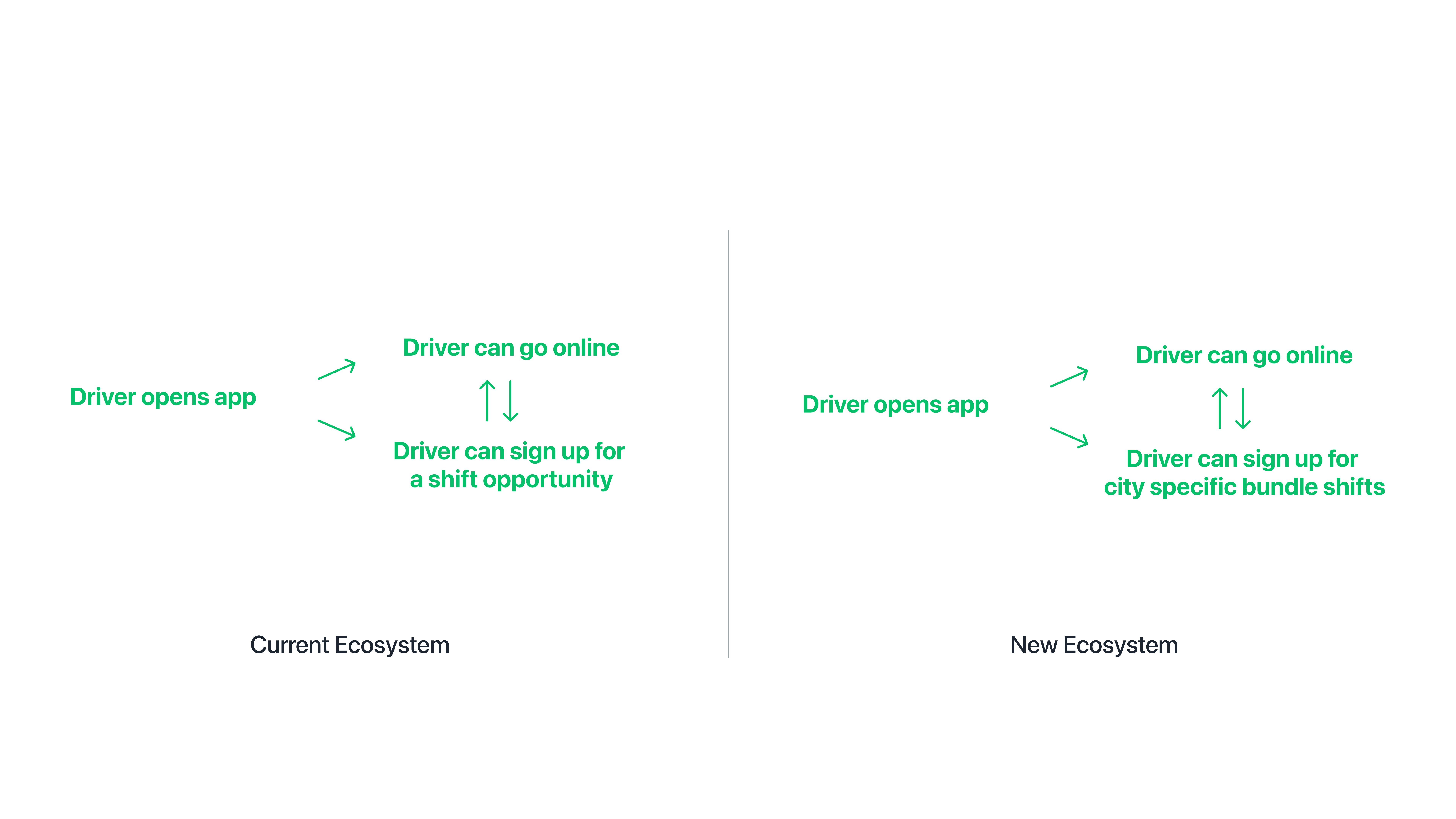
In the current Uber Driver framework, drivers can be routed unpredictably across wide areas when going online (e.g., being sent between far-apart areas like Burlington and South Philadelphia during peak traffic). With this climate positive upgrade, drivers are now remaining local to their selected city, ensuring that orders in distant regions are handled by nearby drivers.
In the current Uber Driver framework, drivers can be routed unpredictably across wide areas when going online (e.g., being sent between far-apart areas like Burlington and South Philadelphia during peak traffic). With this climate positive upgrade, drivers are now remaining local to their selected city, ensuring that orders in distant regions are handled by nearby drivers.
User Journey Map (Customer)
User Journey Map (Customer)
User Journey Map (Driver)
User Journey Map (Driver)
Behavioral Outcome Statement
Behavioral Outcome Statement
What?
What?
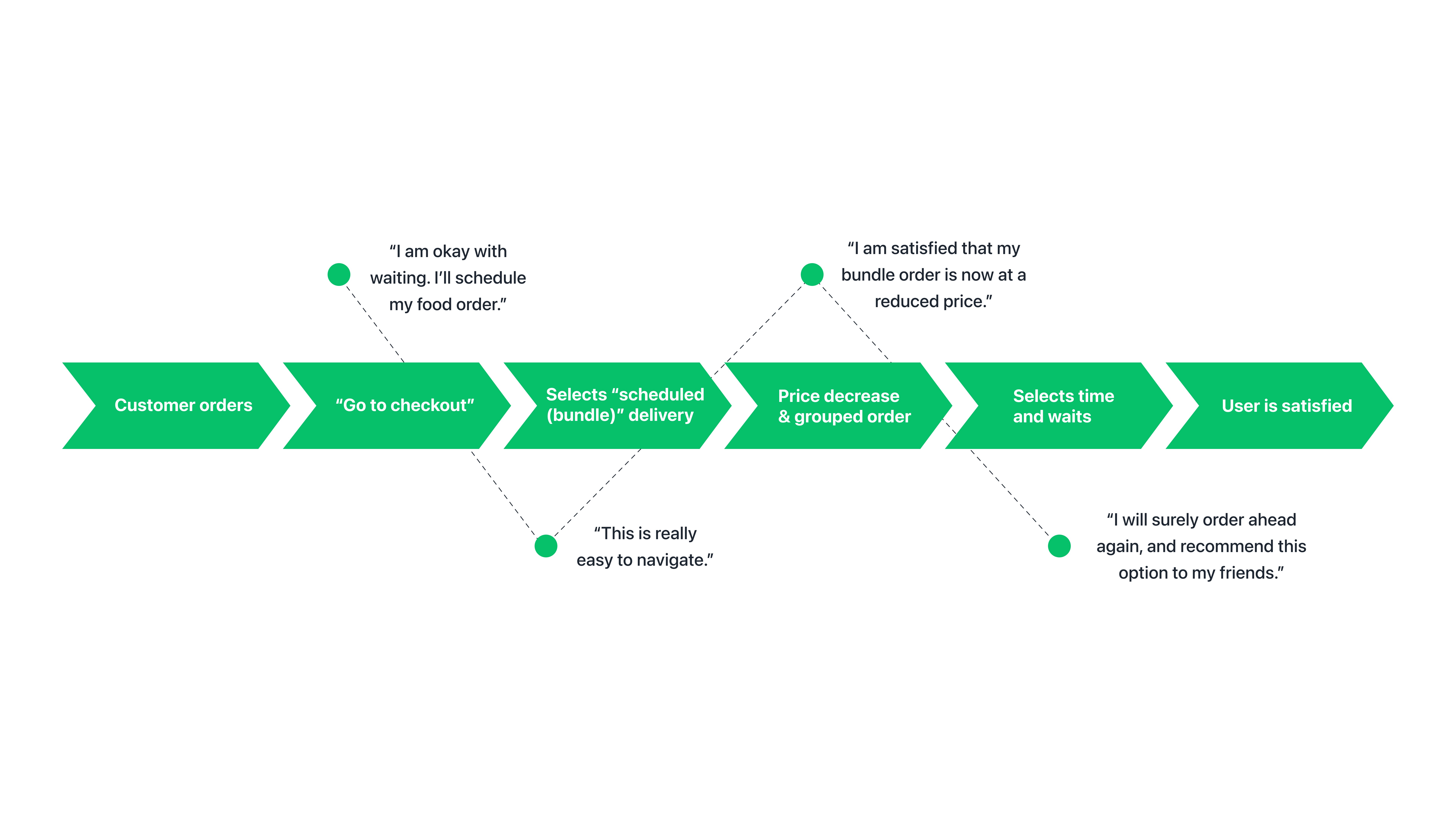
Customers: Because of this change, users now select scheduled bundle deliveries instead of standard delivery, adding their order into a reduced emission bundle.
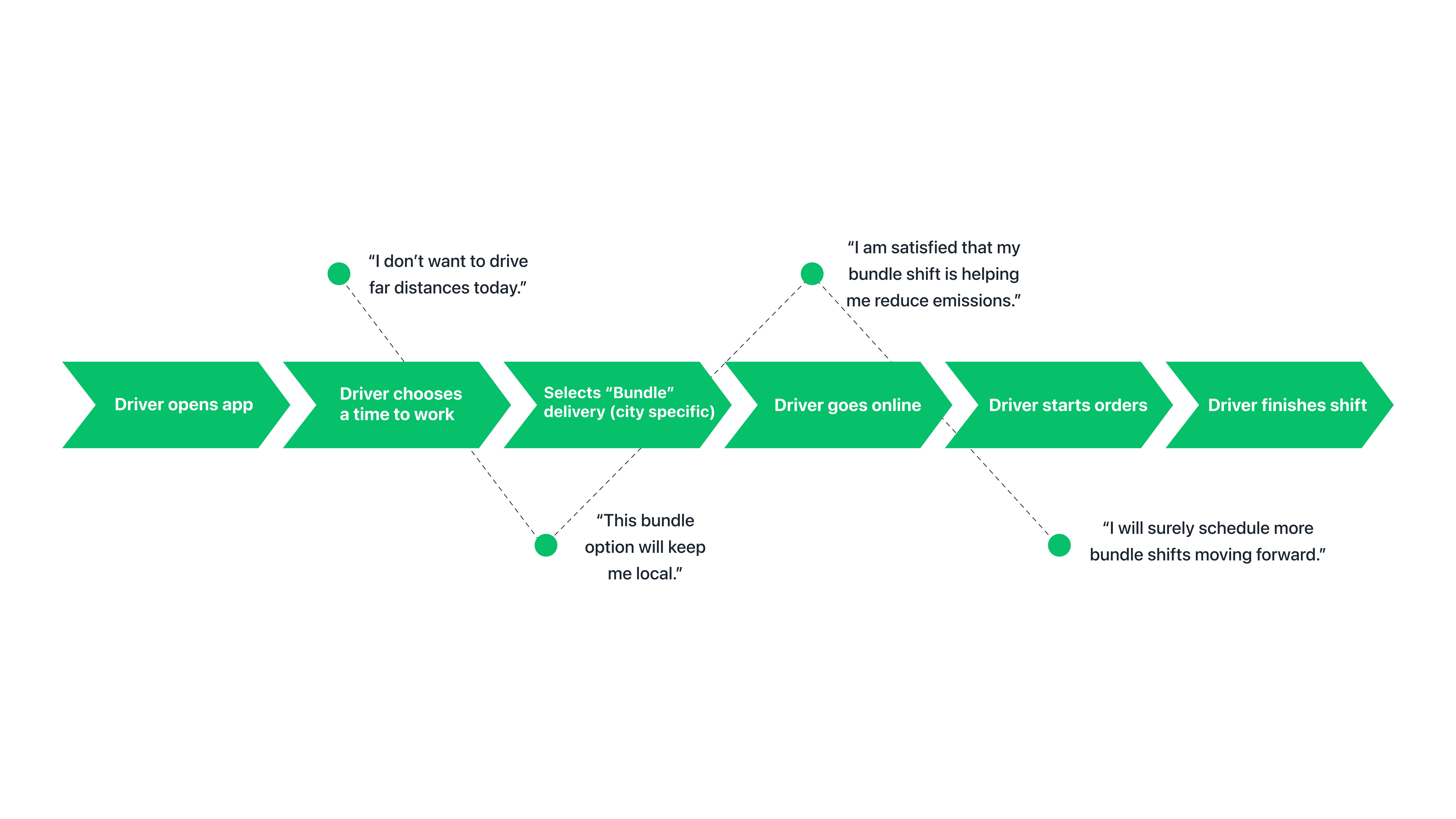
Drivers: Because of this change, drivers now select city specific bundle shifts, helping to reduce their mileage and fuel consumption.
Customers: Because of this change, users now select scheduled bundle deliveries instead of standard delivery, adding their order into a reduced emission bundle.
Drivers: Because of this change, drivers now select city specific bundle shifts, helping to reduce their mileage and fuel consumption.
Design
Design
Uber Eats Prototype
Customers select a scheduled bundle delivery at checkout, joining a grouped order in exchange for a reduced price and a longer wait time.
Customers select a scheduled bundle delivery at checkout, joining a grouped order in exchange for a reduced price and a longer wait time.
Uber Driver Prototype
Drivers sign up for city-specific bundle shifts before going online, committing
to a defined area to reduce back-and-forth routing.
Drivers sign up for city-specific bundle shifts before going online, committing to a defined area to reduce back-and-forth routing.
Drivers sign up for city-specific bundle shifts before going online, committing to a defined area to reduce back-and-forth routing.
RESULTS
RESULTS
Impact + Value
Impact + Value
Hypothesized Impact: Grouping nearby orders into coordinated delivery windows reduces redundant driver mileage, lowering fuel use and emissions per order, while giving Uber a real sustainability story.
Tradeoffs to Test: Customers trade speed for savings, which may hurt opt-in if the discount isn't compelling. Drivers lose flexibility to chase surge pricing elsewhere. Needs real driver behavior data, not assumptions.
Next Steps: If I had more time, I'd (1) pilot this in a single dense urban area to measure real mileage reduction, (2) A/B test opt-in rates for scheduled bundles vs. standard delivery, (3) interview drivers about willingness to commit to a fixed city zone, and (4) model the discount threshold that works for both sides.
Hypothesized Impact: Grouping nearby orders into coordinated delivery windows reduces redundant driver mileage, lowering fuel use and emissions per order, while giving Uber a real sustainability story.
Tradeoffs to Test: Customers trade speed for savings, which may hurt opt-in if the discount isn't compelling. Drivers lose flexibility to chase surge pricing elsewhere. Needs real driver behavior data, not assumptions.
Next Steps: If I had more time, I'd (1) pilot this in a single dense urban area to measure real mileage reduction, (2) A/B test opt-in rates for scheduled bundles vs. standard delivery, (3) interview drivers about willingness to commit to a fixed city zone, and (4) model the discount threshold that works for both sides.
More works